Welcome to China Traffic Cone Supplier & Road Safety Products | SLOAN SAFETY
How to Identify a Good Traffic Cone: A Product Quality Guide
A traffic cone is a relatively simple product. But when you compare samples from different manufacturers, you may notice quite a few differences.
Some cones feel soft and flexible. Others are much harder. Some have a heavy, stable base, while others are easy to move. The reflective tape may also look similar at first, but perform quite differently at night.
For importers and distributors, these differences matter. A traffic cone may look good in a quotation or product photo, but the actual product quality can only be understood by looking at the details.
After working with traffic safety products for many years, these are the main points we recommend checking when evaluating a traffic cone sample.
1. Start With the Cone Material
For professional traffic cones, PVC is one of the commonly used materials, particularly where flexibility and impact resistance are important.
The material itself, however, is only part of the story.
Two suppliers may both offer a "PVC traffic cone", but the finished products can feel quite different because of differences in raw materials and formulation.
When checking a sample, look at the surface first.
A well-produced cone should have a reasonably smooth and consistent surface, without obvious:
• Air bubbles
• Cracks
• Black spots
• Excessive particles
• Uneven color
• Molding defects
Then check the flexibility.
A good PVC cone should be flexible enough to deform under normal impact and recover its shape afterward. This is one reason PVC is widely used for traffic cones and other flexible traffic safety products.
Don't judge the material only by how soft it feels. The right hardness depends on the product design and its intended application.
2. Don't Compare Traffic Cones by Weight Alone
Weight is one of the first specifications buyers usually ask about.
It is important, especially when stability is required. But a heavier cone is not automatically a better cone.
The finished weight can come from different parts of the product, including the cone body and the base. In some PVC products, mineral fillers such as calcium carbonate may also be used to increase density.
This is why two cones with similar dimensions can have different weights and different prices.
For example, if one 70 cm cone weighs 3 kg and another weighs 4 kg, I would not immediately conclude that the 4 kg cone is better.
I would ask:
Where does the additional weight come from?
Is it:
• A heavier and better-designed base?
• More PVC material?
• A different formulation?
• Additional filler?
The answer is more useful than the weight itself.
For an importer, this is also important when comparing quotations from different factories. Weight should always be considered together with material, construction and stability.
3. Check the Base — Stability Is More Than Weight
The base is one of the most important parts of a traffic cone.
Its job is not simply to make the cone heavier. The shape, size, material and distribution of weight all affect how the cone sits on the ground.
A properly designed base should:
• Sit flat on the ground
• Provide sufficient stability
• Resist unnecessary movement
• Maintain a secure connection with the cone body
• Be suitable for the intended working environment
A wide, weighted base generally provides better stability, particularly in outdoor applications where wind or passing vehicles can move lightweight products.
However, there is always a balance between stability and handling.
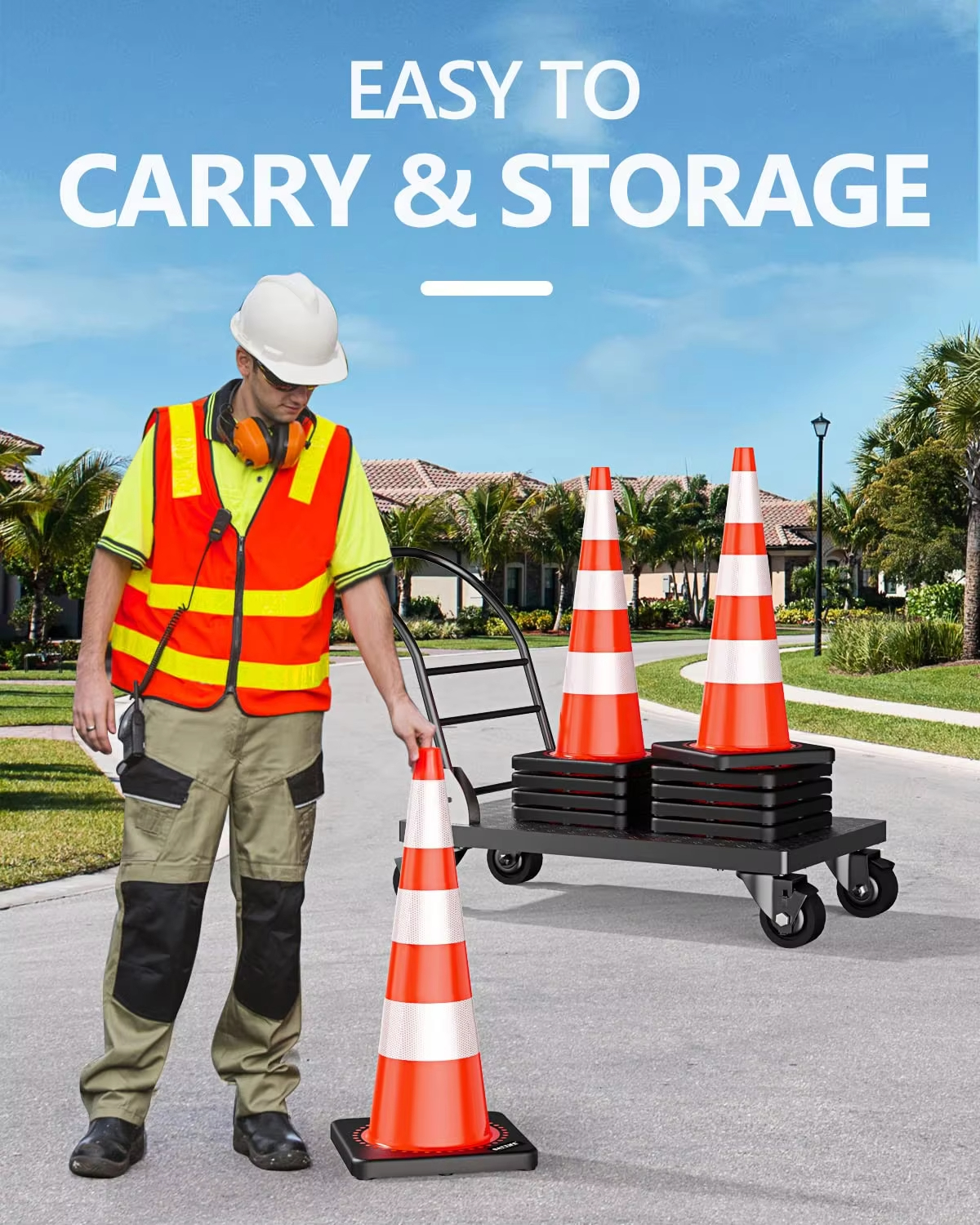
A cone that is extremely heavy may be stable, but it can also become inconvenient for workers to carry, deploy and collect.
So the right question is not:
"How heavy is the base?"
It is:
"Is the base stable enough for the application?"
4. Check How the Cone Recovers After Bending
This is a simple test that can tell you quite a lot about the cone material.
Take the sample and carefully bend the cone body. After releasing it, see how well it returns to its original shape.
A suitable flexible traffic cone should be able to deform under normal impact and recover without obvious permanent creasing or cracking.
This is especially relevant for PVC cones designed for repeated use. Manufacturers of commercial PVC cones commonly highlight reboundability, flexibility and impact resistance as important product characteristics.
Of course, this simple test is not a substitute for laboratory testing. But when you are comparing several samples side by side, it is a useful first check.
5. Look Closely at the Reflective Collar
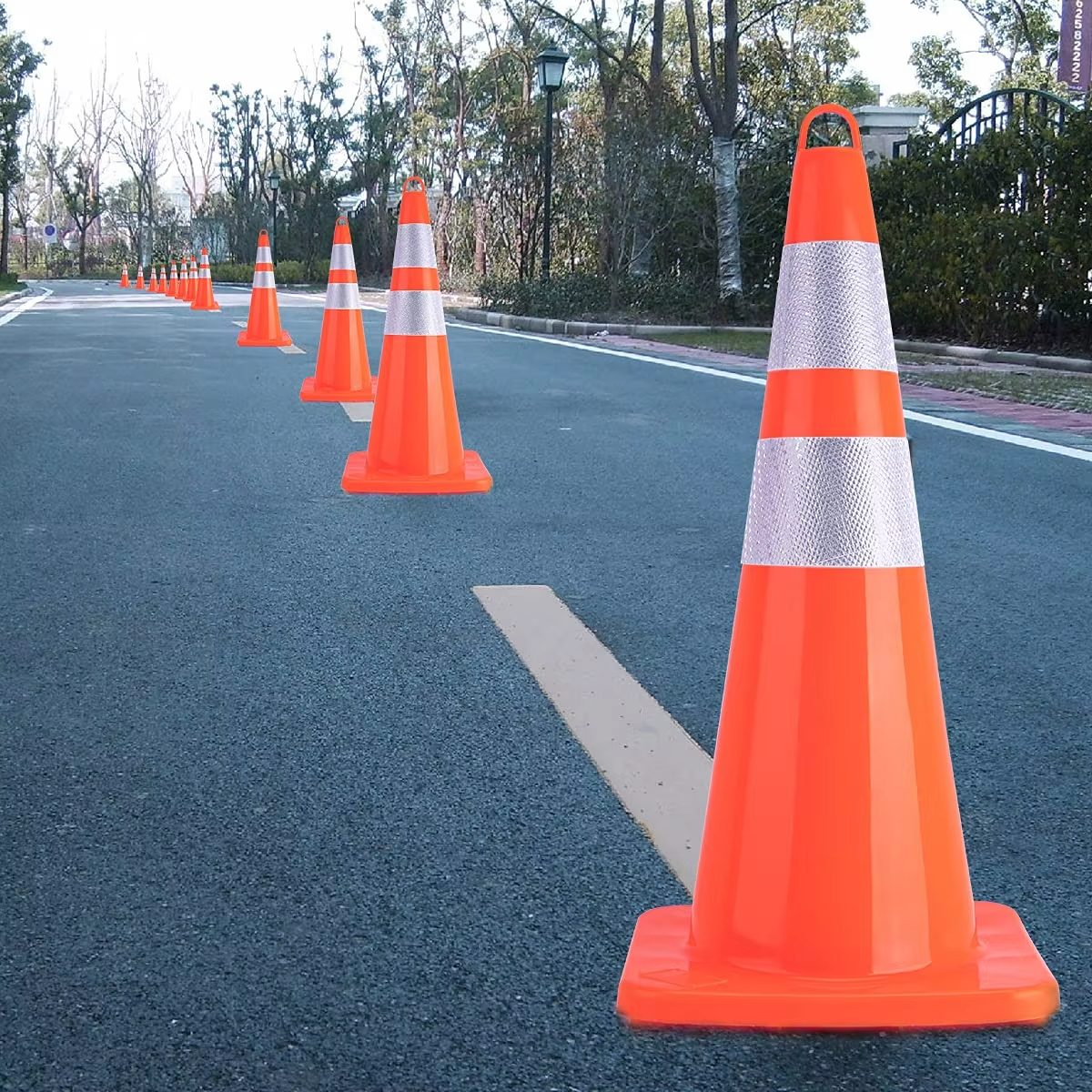
For cones used at night or in low-light conditions, the reflective collar is not just a decorative white stripe.
Its purpose is to return light from vehicle headlights toward the driver, making the cone easier to see.
When checking a sample, I recommend looking at two things separately:
Reflective performance
Check whether the material provides the level of retroreflectivity required for the application and local regulations.
Physical quality
Look closely at the actual installation.
Check for:
• Lifting edges
• Wrinkles
• Bubbles
• Uneven application
• Poor alignment
• Weak adhesion
Some manufacturers also recess the reflective sheeting slightly into the cone body to reduce damage during handling and stacking.
This is a good example of why a product photograph doesn't tell you everything. Two cones may look almost identical online, while the reflective material and installation quality are different.
6. Know Which Reflective Film You Need
When buying traffic cones from China, it is important to specify the type of reflective film you want.
Many buyers simply ask for a “white reflective collar.” This can be a problem because suppliers may use different types of reflective materials while quoting for what appears to be the same product.
For most traffic cone suppliers in China, you will commonly see three options.
White Reflective Film with Tape Fixing
This is a relatively simple and economical option.
The white reflective film is wrapped around the cone, and the joint is secured with adhesive tape.
You can usually recognize it easily from the outside because the fixing tape or joint is visible.
This option is commonly used when the main consideration is cost, and the cone is intended for relatively basic applications.
When requesting a quotation, you can specify:
White reflective film with tape fixing
White Self-Adhesive Reflective Film
The second option is white self-adhesive reflective film.
The film has an adhesive backing and is applied directly to the surface of the traffic cone. There is normally no additional fixing tape visible from the outside.
Compared with the first option, it gives the cone a cleaner and more finished appearance.
When requesting a quotation, you can specify:
White self-adhesive reflective film
It is also worth confirming the adhesive quality if the cones will be used outdoors for an extended period.
High-Intensity Reflective Sheeting
The third option is high-intensity reflective sheeting.
This is a higher-performance reflective material and is commonly used when nighttime visibility is more important.
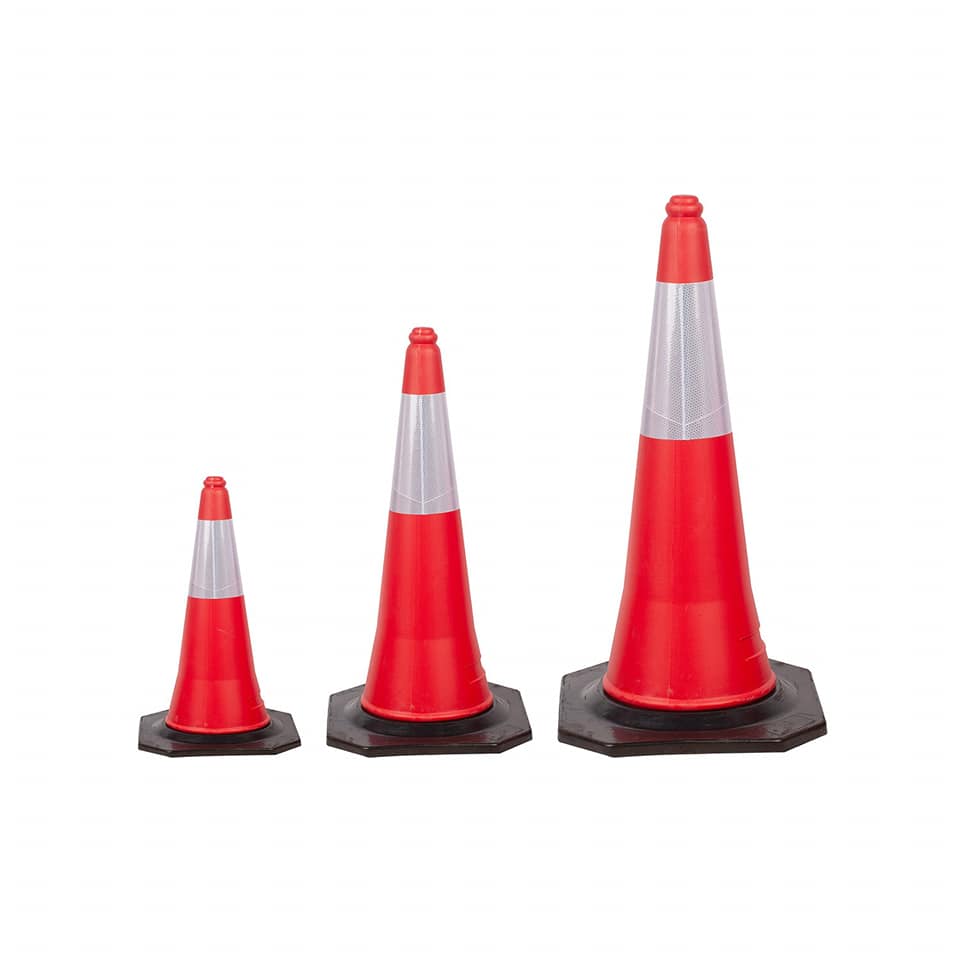
One easy way to distinguish it visually is the surface color. Unlike the bright white appearance of the first two options, high-intensity sheeting generally has a gray or silver-gray appearance when viewed in daylight.
This difference is quite obvious when the three types are placed side by side.
For applications where stronger nighttime visibility is required, you can specify:
High-intensity reflective sheeting
If a particular road authority or project has a required reflective standard, the specification should be confirmed with the supplier rather than relying on the material name alone.
Which One Should You Specify?
The three options can be summarized simply:
| Reflective Film | Appearance | Typical Positioning | Cost |
|---|---|---|---|
| White film with tape fixing | White, visible fixing/joint | Basic / economical | $ |
| White self-adhesive film | Clean white surface | Standard | $$ |
| High-intensity reflective sheeting | Gray / silver-gray | Higher visibility requirements | $$$ |
The important point is that “white reflective film” is not a complete specification.
If you are importing traffic cones, tell your supplier exactly which type you want.
For example:
70 cm PVC traffic cone + 1.75kgs + white self-adhesive reflective film
or:
90 cm PVC traffic cone + high-intensity reflective sheeting
This makes it much easier to compare quotations from different suppliers because everyone is pricing the same basic specification.
A simple way to remember the three options
White + tape → economical
White + self-adhesive → standard and cleaner appearance
Gray/silver-gray → high-intensity reflective sheeting
Of course, the actual reflective performance and durability can still vary between manufacturers. If your project has specific visibility or compliance requirements, make sure those requirements are included in the product specification.
7. Check the Color and Surface Finish
The orange color is one of the most recognizable characteristics of a traffic cone.
For distributors, however, color consistency is more than an appearance issue. If you are buying repeated production batches, noticeable differences between shipments can become a problem.
When checking a sample, look for:
• Consistent orange color
• Smooth surface
• No obvious contamination
• No black or white particles
• No excessive molding marks
For outdoor products, also ask how the material is designed to resist fading and weather exposure.
Some commercial cones use fluorescent orange material throughout the cone body to help maintain visibility and reduce the effect of surface wear.
If your cones will remain outdoors for long periods, UV resistance should be part of the product specification rather than an assumption.
A Practical Traffic Cone Sample Inspection
When we compare samples from different manufacturers, we don't rely on one specification.
We look at the whole product.
| Item | What to Check |
|---|---|
| Height | Is it consistent with the required specification? |
| Cone material | Flexibility, hardness and overall appearance |
| Surface | Smoothness, color consistency and molding quality |
| Weight | Actual weight compared with the specification |
| Base | Size, weight distribution and stability |
| Cone recovery | Does the body return to shape after bending? |
| Reflective collar | Material, width, appearance and adhesion |
| Cone/base connection | Secure fit and alignment |
| Outdoor suitability | UV and weather resistance |
| Stacking | Does the product stack properly without unnecessary sticking or damage? |
This kind of inspection will not replace formal certification or laboratory testing when a project requires it.
But it is a practical way to identify obvious differences between samples before moving to a larger order.
Why Two Traffic Cones With the Same Specifications Can Be Different?
This is something importers often discover only after comparing physical samples.
A quotation may show:
700 mm / PVC / Orange / 3 kg / Reflective
But those five specifications don't tell you everything about the finished product.
They don't tell you:
• What type of PVC formulation was used
• How the material behaves when impacted
• Where the weight comes from
• How the base is designed
• What reflective sheeting is being used
• How the reflective collar is attached
• How the product performs after long-term outdoor exposure
This is why sample approval is important.
A product specification tells you what the supplier says they will make.
The sample lets you see what they actually make.
What Should a Good Traffic Cone Look Like?
There isn't one specification that defines a good traffic cone.
A well-designed product should have a reasonable balance between:
Visibility + Stability + Flexibility + Durability + Handling
The right balance depends on the application.
For a warehouse, you may prefer a lighter and easier-to-handle cone.
For road construction, stability and nighttime visibility may be more important.
For long-term outdoor use, material quality and weather resistance become more important.
So instead of asking:
"What is the best traffic cone?"
I think the better question is:
"What traffic cone is suitable for this application?"
Before Approving a Traffic Cone Sample
If you are an importer or distributor, I recommend keeping the inspection simple.
Before approving a sample, check:
1. Measure it
Confirm the height, base dimensions and weight.
2. Check the material
Look at the surface and test the flexibility.
3. Check the base
Make sure it sits flat and provides the required stability.
4. Check the reflective collar
Confirm the material, dimensions and adhesion.
5. Consider the application
The right specification depends on where the cone will be used.
6. Keep the approved sample
Use it as the physical reference for future production.
If you are a importer,you can know more detail from here.