Welcome to China Traffic Cone Supplier & Road Safety Products | SLOAN SAFETY
PVC vs PE Traffic Cones: Which Material Should You Choose?
PVC vs PE Traffic Cones: Construction, Flexibility and Price Differences
When choosing traffic cones, buyers often compare PVC vs PE traffic cones because the two materials are widely used in the market.
At first glance, the difference may seem simple: PVC is flexible, while PE is more economical. In practice, however, the two types of cones are usually different not only in material, but also in construction, available sizes, base design, flexibility and price.
For buyers sourcing traffic cones from China, understanding these differences can make it easier to specify the right product instead of simply asking for a “PVC cone” or “PE cone.”
PVC vs PE Traffic Cones at a Glance
| Feature | PVC Traffic Cone | PE Traffic Cone |
|---|---|---|
| Common Heights | 30, 45, 70, 90 cm | 50, 75, 100 cm |
| Construction | Usually one-piece | Usually two-piece |
| Cone Body | PVC | PE |
| Base | Integrated with the cone | Usually separate rubber or recycled PVC base |
| Flexibility | High | Generally lower |
| Impact Recovery | Can bend and bounce back | Depends on product design |
| Price | Generally higher | Generally more economical |
| Main Advantage | Flexibility and bounce-back recovery | Cost and practical construction |
| Typical Applications | Road work, traffic control, active work zones | Parking, temporary warning, general traffic control and cost-sensitive applications |
The differences above are general market characteristics. Specific products can vary depending on the formulation, manufacturing process, base design and overall construction.
What Is a PVC Traffic Cone?
PVC traffic cones are generally manufactured using polyvinyl chloride (PVC) as the main material.
One of the most noticeable characteristics of PVC cones is their flexibility. A well-formulated PVC cone can bend when it is hit or driven over and then bounce back toward its original shape.
This makes PVC particularly suitable for situations where traffic cones may experience repeated contact with vehicles or equipment.
Common PVC Traffic Cone Heights
PVC traffic cones are commonly available in:
30 cm
45 cm
70 cm
90 cm
Unlike many PE cones, PVC cones are commonly produced as an integrated one-piece structure.
The cone body and base are formed together rather than using a separate heavy base.
PVC cones can be produced in different appearances, including:
All-red PVC cones
Red cone with an integrated black base
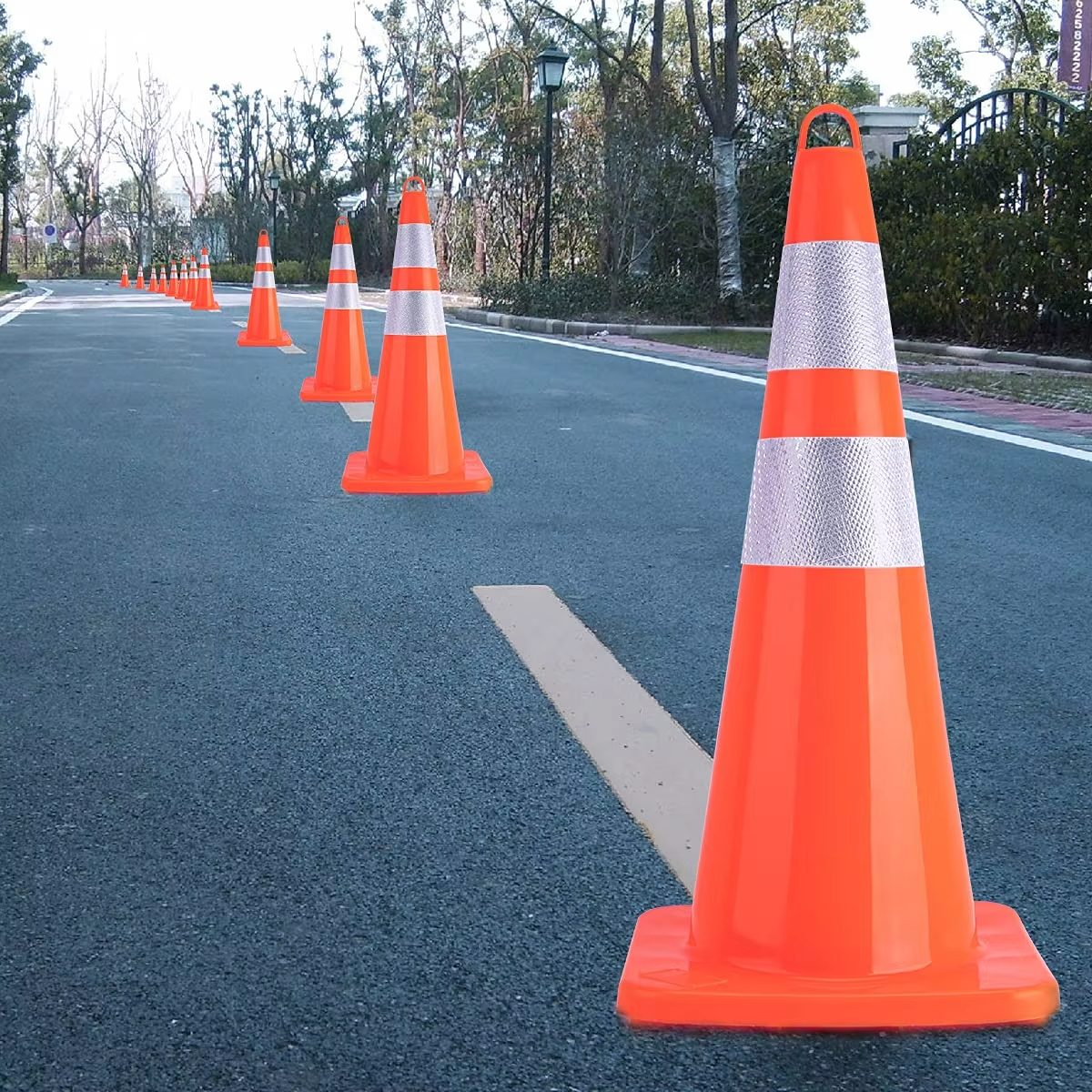
Cones with reflective bands or sleeves
The exact design depends on the manufacturer's tooling and the buyer's requirements.
What Is a PE Traffic Cone?
PE traffic cones are generally made using polyethylene (PE) for the cone body.
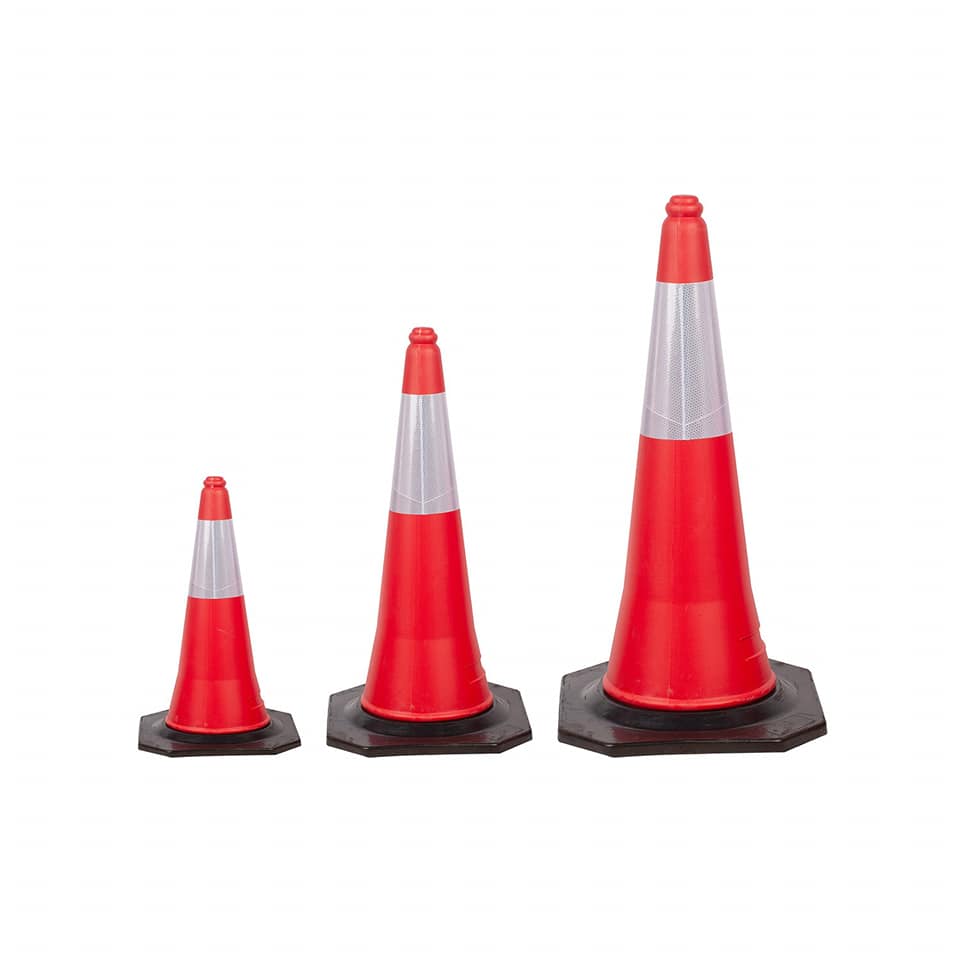
Compared with PVC cones, PE traffic cones are commonly produced using a two-piece construction.
The typical structure consists of:
PE cone body + separate base
The base may be made from:
Rubber
Recycled PVC
Other suitable recycled or composite materials
This construction allows the cone body and base to be manufactured separately.
Common PE Traffic Cone Heights
PE traffic cones are commonly found in:
50 cm
75 cm
100 cm
The two-piece design is particularly common for larger PE cones.
Because the cone body and base are separate components, manufacturers can offer different combinations of cone body and base according to the required application, weight and price level.
The Main Difference: One-Piece vs Two-Piece Construction
One of the easiest ways to distinguish typical PVC and PE traffic cones is their construction.
PVC: Usually One-Piece
A typical PVC traffic cone has the cone body and base integrated into one structure.
This gives the product a relatively simple appearance and allows the entire cone to flex when impacted.
When a vehicle drives over or knocks against the cone, the flexible PVC body can deform and then recover.
PE: Usually Two-Piece
A typical PE traffic cone consists of a PE cone body installed into a separate base.
The base provides additional stability while the PE body provides the visible warning structure.
The separate-base design also gives manufacturers more flexibility when controlling the overall weight and cost of the product.
Therefore, when comparing PVC and PE cones, it is important to look at the complete construction, rather than comparing the polymer name alone.
PVC Traffic Cones: Flexibility and Bounce-Back
For many buyers, the biggest reason to choose PVC is its flexibility.
A flexible traffic cone is useful when cones may be:
Knocked over by vehicles
Driven over accidentally
Bent during handling
Used repeatedly in active work zones
Instead of remaining permanently deformed after every impact, a flexible PVC cone can often return toward its original position.
This bounce-back behavior is one of the practical advantages of PVC traffic cones.
However, flexibility depends on the actual PVC formulation and manufacturing process. Simply describing a product as “PVC” does not automatically tell you how flexible it will be.
For this reason, buyers should evaluate the finished product rather than relying only on the material name.
PE Traffic Cones: A More Economical Option
PE traffic cones are generally more economical than PVC traffic cones, especially for standard two-piece designs.
One reason is the common construction:
PE cone body + separate base
This allows the manufacturer to produce the cone body and base separately and select different base materials or designs according to the required price and performance.
PE cones can therefore be a practical option when the buyer's priority is:
Lower purchasing cost
Simple traffic control
Easy handling
Large-volume projects
Parking areas
Temporary warning
Lower-impact applications
A lower price does not necessarily mean that a PE traffic cone is a poor-quality product.
It simply means that the product is designed around a different balance between cost, construction and performance.
Is PVC Always Better Than PE?
No.
The question should not be:
“Is PVC better than PE?”
A better question is:
“Which material and construction are more suitable for my application?”
PVC has a clear advantage when flexibility and impact recovery are important.
PE can be a better choice when cost and practical construction are more important.
For example:
Choose PVC when:
The cone may be repeatedly hit or run over
Flexibility is important
Bounce-back performance is desired
The cones are used in active road work zones
Long-term repeated handling is expected
Choose PE when:
The project is highly price-sensitive
The application involves relatively limited impact
A two-piece cone is preferred
Different base options are useful
The cones are mainly used for parking, temporary warning or general traffic control
Why Are PE Traffic Cones Usually Cheaper?
There is no single reason why PE cones are cheaper.
The final price of a traffic cone depends on several factors, including:
Material
Product construction
Cone height
Cone weight
Base material
Reflective material
Manufacturing process
Packaging
Order quantity
However, in typical market configurations, PE traffic cones are often positioned at a lower price level than flexible PVC cones.
The two-piece construction is an important factor because the PE body and base can be produced separately.
This also makes it possible to use different base materials, including rubber or recycled PVC, depending on the target specification.
Therefore, if a buyer is comparing quotations from Chinese suppliers, it is important to make sure that the two products being compared have similar specifications.
A lower quotation may simply represent a different material, construction, weight or base configuration.
Does a Heavier Cone Mean a Better Cone?
Not necessarily.
Weight should not be used as the only measurement when comparing PVC and PE traffic cones.
A cone's weight can be affected by:
Material formulation
Cone wall thickness
Base design
Base material
Product size
Manufacturing process
For example, a PE cone with a heavy rubber base may weigh considerably more than a lightweight PVC cone.
Therefore, material and weight should be specified separately when requesting a quotation.
If you are comparing different cone weights, see our [Traffic Cone Weight Guide] for a more detailed explanation.
PVC vs PE: Which One Should You Buy?
There is no universal winner.
The simplest way to make the decision is to identify your main priority.
If flexibility and bounce-back recovery are the priority, PVC is generally the better starting point.
If a more economical two-piece solution is the priority, PE is generally the more practical choice.
Here is a simple way to think about it:
PVC → Flexibility → Impact recovery → Active work zones
PE → Economy → Two-piece construction → General and cost-sensitive applications
Of course, the final specification should also consider the required height, weight, base design, reflective material and local requirements.
How to Specify PVC or PE Traffic Cones When Buying from China
Instead of sending a supplier a message such as:
“Please quote PVC traffic cones.”
It is better to provide the basic specification.
For example:
70 cm PVC traffic cone, one-piece construction, flexible body, with reflective bands, required quantity: 5,000 pcs.
Or:
75 cm PE traffic cone, two-piece construction, PE cone body with rubber base, required quantity: 5,000 pcs.
If you do not know which material is suitable, you can simply tell the supplier:
Application
Cone height
Quantity
Traffic environment
Expected impact
Target price
Destination country
An experienced supplier should then be able to recommend a suitable material and construction.
PVC vs PE Traffic Cones: Final Comparison
PVC and PE traffic cones are not simply two versions of the same product.
They are commonly supplied with different heights, constructions, base designs, flexibility and price levels.
PVC traffic cones are commonly available in 30, 45, 70 and 90 cm and are usually produced as an integrated one-piece cone. Their main advantage is flexibility and the ability to bend and bounce back after impact.
PE traffic cones are commonly available in 50, 75 and 100 cm and are usually made with a separate cone body and base. They are generally more economical and can be a practical choice for applications where repeated impact recovery is less important.
The right choice depends on the application—not simply on which material sounds better.
Need Help Choosing Between PVC and PE?
If you are not sure which traffic cone is suitable for your project, send us your:
Required height
Quantity
Application
Destination country
Expected traffic environment
Target specification or price
Our team can recommend a suitable PVC or PE traffic cone construction and provide a quotation based on your actual requirements.
Looking for a China traffic cone supplier? Contact SLOAN-SAFETY for a product recommendation and quotation.