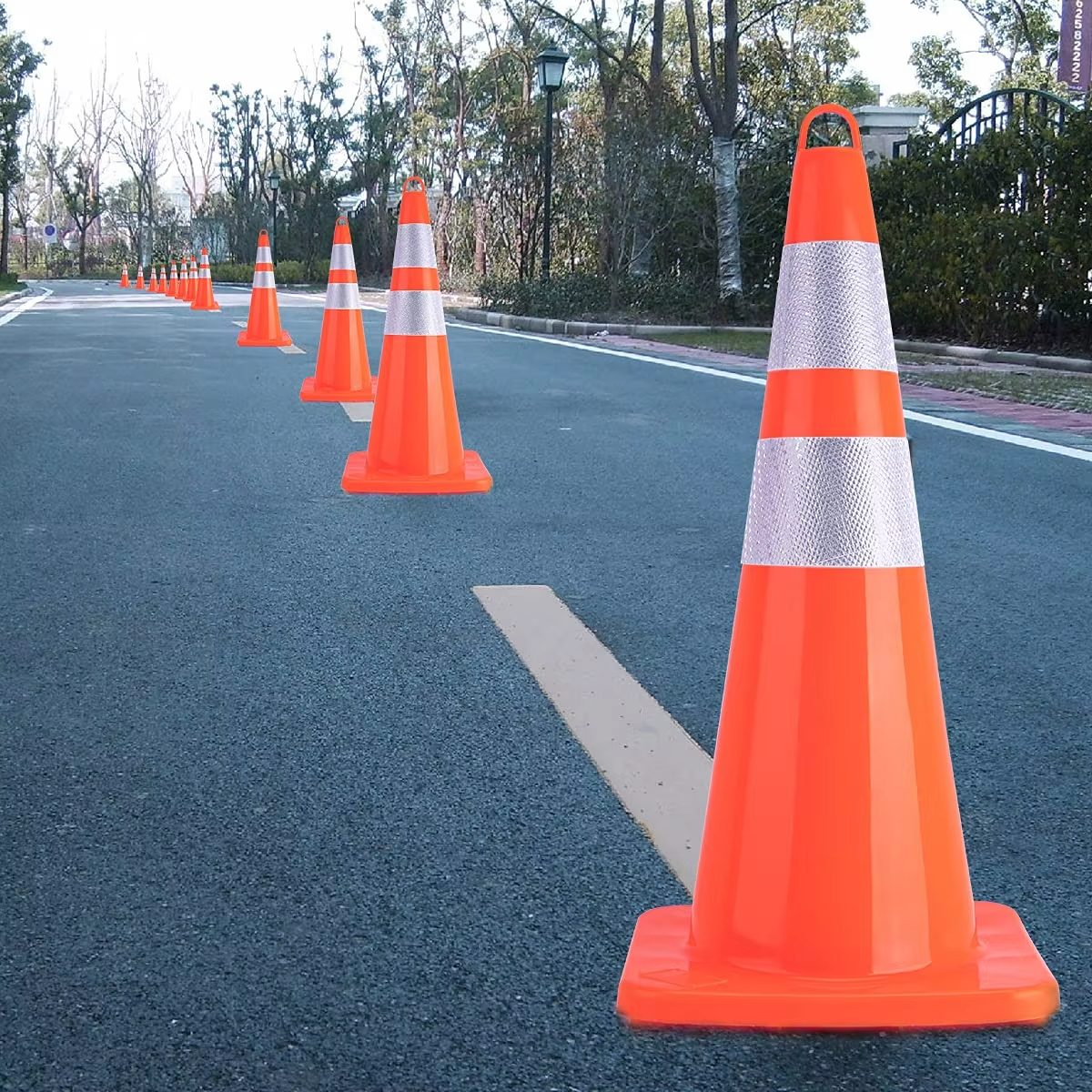
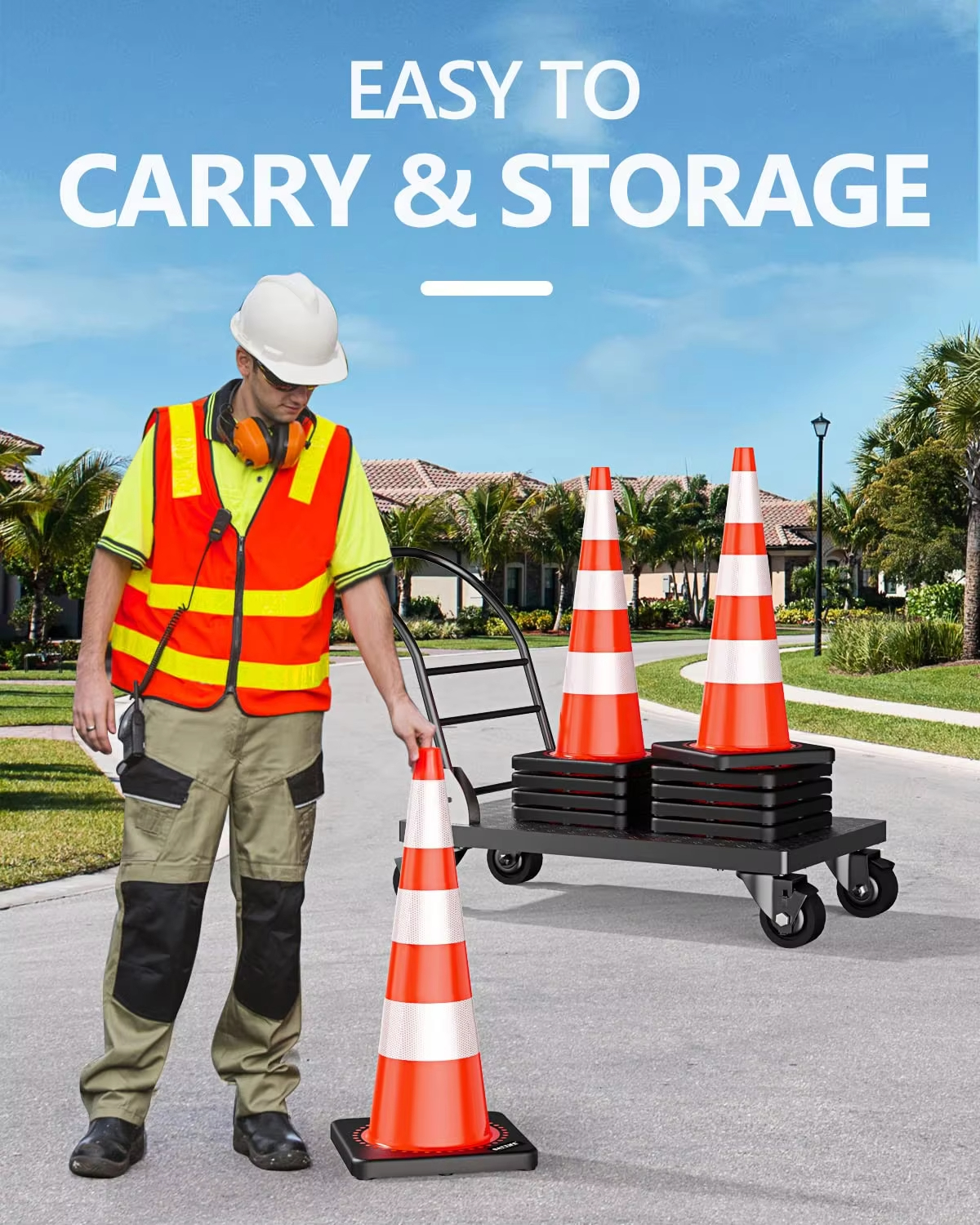
Welcome to China Traffic Cone Supplier & Road Safety Products | SLOAN SAFETY
How to Search Traffic Cones Suppliers from China: What Global Buyers Should Know
Importing traffic cones is not simply about finding the lowest FOB price.
For distributors and importers, the real cost and product performance depend on several factors: cone size, weight, base design, reflective material, packaging, loading quantity, quality consistency and destination-market requirements.
A traffic cone that works well for one market may not be the right choice for another. A lower unit price can also become less attractive if the product has a lower loading quantity or higher freight cost.
SLOAN-SAFETY supplies PVC traffic cones and reflective traffic cones for importers, distributors, contractors and road safety companies. We help customers select suitable specifications based on their market, application, quantity and logistics requirements.
What Should You Consider Before Importing Traffic Cones from China?
Before asking suppliers for a quotation, it is useful to define several basic specifications.
At minimum, you should consider:
Traffic cone height
Product weight
Base dimensions
Reflective tape
Color
Packaging (Pallet or woven bag)
Required quantity
Destination port
These details can significantly affect the final purchasing cost.
For example, two suppliers may quote the same price for a 70cm traffic cone, but the products may have different weights, base sizes, reflective materials and packing methods.
Therefore, comparing only the unit price can give you the wrong impression.
1. Which Traffic Cone Size Should Importers Choose?
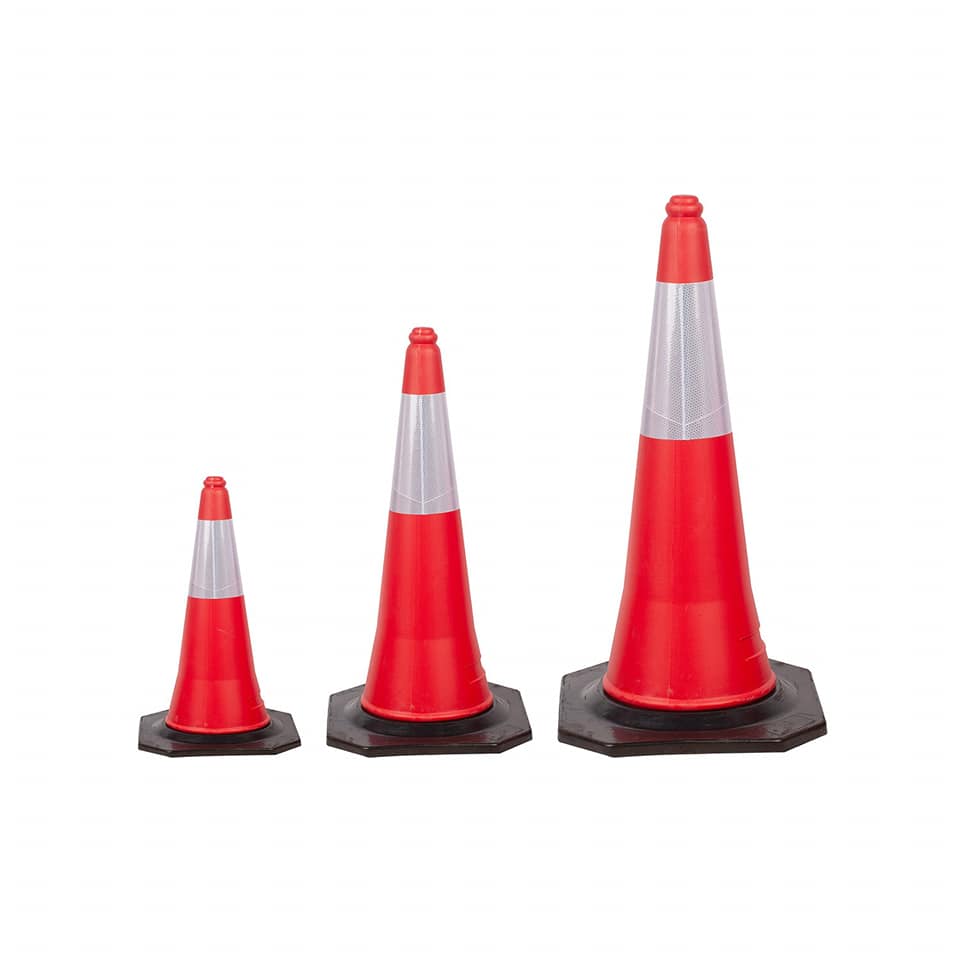
The most common sizes requested by our customers include 45cm, 70cm and 90cm.
But choosing the right size is not simply a matter of choosing the largest cone.
45cm Traffic Cone
A 45cm cone is compact and easy to handle.
It can be suitable for:
Parking areas
Warehouses
Factories
Indoor use
General hazard marking
For distributors, it can also be useful as a lower-cost or compact product option.
70cm Traffic Cone
70cm is a practical size for many general road safety and construction applications.
It provides a good balance between:
Visibility + Stability + Handling + Transportation
If you are developing a general-purpose traffic cone range, this is one of the sizes worth considering.
90cm Traffic Cone
A 90cm cone provides greater visual presence and is often selected for road construction, temporary traffic control and applications where greater visibility is required.
However, the final specification should always be checked against the requirements of your target market.
2. How Much Should a Traffic Cone Weigh?
One of the first things we recommend importers check is the actual weight of the traffic cone.
There is no single standard weight for every PVC traffic cone. The weight can vary significantly even when two cones have the same height.
For example, common specifications may include:
| Cone Height | Common Weight Options |
|---|---|
| 45cm | 1.0 kg / 1.4 kg |
| 70cm | 1.75 kg / 2.25 kg / 3.2 kg |
| 90cm | 3.4 kg / 4.0 kg / 4.5 kg |
These are only examples. Different markets and manufacturers may offer other weight configurations.
Why Can the Same Size Have Different Weights?
For PVC traffic cones, the basic product configuration is normally determined when the mold is developed.
The mold determines important physical characteristics such as:
Cone dimensions
Wall structure
Base dimensions
Material distribution
Overall product shape
However, the traffic cone market in China is highly competitive.
To maintain a competitive price, some suppliers may continuously modify or optimize their molds to reduce material consumption and lower the finished product weight.
This can create a situation where two suppliers both quote:
70cm PVC Traffic Cone
but one product weighs 1.70-1.8 kg, while another weighs 1.6-1.7 kg .
They may look similar in a product photo, but they are not necessarily the same product specification.
Weight Has a Direct Impact on Price
For PVC traffic cones, raw material is one of the major components of the product cost.
The relationship is relatively straightforward:
More material → Higher product weight → Higher material cost
And for international buyers, there is another factor:
Higher weight → Higher shipping weight
This means that product weight can influence both the FOB price and logistics cost.
For example, a supplier offering a very low price may not necessarily have a better production cost. The product may simply use less material.
This is why we recommend that importers never compare traffic cones based only on:
Height + Unit Price
Instead, compare:
Height + Actual Weight + Base Design + Material + Reflective Specification + Packing
A Heavier Cone Is Not Always Better
It is important to understand that a heavier traffic cone does not automatically mean a better traffic cone.
For PVC products, weight can come from different factors, including the amount of PVC material, the product structure and the formulation used by the manufacturer.
In some cases, a manufacturer may increase the weight by adding a relatively high amount of calcium carbonate (CaCO₃) filler to the PVC formulation. This can increase the density and weight of the finished product without providing the same improvement in flexibility or impact performance that you would expect from simply using more PVC material.
This is why comparing traffic cones by weight alone can be misleading.
A professional supplier should be able to explain the differences between the available weight options and help you select a practical specification.
3. Traffic Cone Base: One-Piece or Black Interlock Base?
The base plays an important role in determining a traffic cone's stability, weight and overall cost.
When sourcing PVC traffic cones, importers will commonly see two types of construction:
One-piece molded traffic cone with a same-color base
Traffic cone with a black interlock base
Although both are supplied and used as a complete traffic cone, their construction and material configuration are different.
One-Piece Molded Traffic Cone
In this design, the cone body and base are produced as one complete piece through a single molding process.
The cone and base are the same color, normally orange, giving the product a uniform appearance.
The main advantages include:
One-piece construction
No separate assembly
Uniform color
Simple production structure
Easy handling
For general-purpose traffic control, parking areas and other applications where a lighter and more economical cone is required, this can be a practical option.
However, the final stability depends on the overall weight, base dimensions and material distribution. Two one-piece cones with the same height can still have different levels of stability.
Black Interlock Base Traffic Cone
The second common construction uses an orange cone body with a black interlock base.
Unlike the one-piece molded design, the black base and orange cone body are produced separately and then connected through an interlock structure. Once assembled, they function as one complete traffic cone and do not need to be separated during normal use.
The black base is commonly produced using black PVC recycled or reprocessed material. Because more material can be concentrated in the lower part of the cone, this construction is often used when a heavier and more stable base is required.
The heavier base helps lower the center of gravity and increases the contact area with the ground, making this configuration popular for:
Road construction
Outdoor traffic control
Construction sites
Parking areas
Temporary road work
Another practical advantage is that the black base tends to hide dirt, tire marks and other stains better during outdoor use.
4. Reflective Tape: Make Sure You Specify the Right Type
Reflective tape is one of the details that importers should clarify before placing an order. Simply telling a supplier that you need a “reflective traffic cone” may not be enough.
We once had a customer from South America who told us after receiving traffic cones from another supplier. Their main complaint was simple:
The reflective tape could be removed from the cone too easily.
After checking the product more carefully, we found the actual reason.
The reflective material used on those cones was not a self-adhesive reflective film. Instead, a piece of reflective material had been attached to the cone using an additional adhesive tape.
This created a weak point between the reflective material and the cone surface. With regular handling, outdoor exposure and repeated contact, the reflective strip could gradually loosen and be pulled off.
For the customer, this was not simply a cosmetic problem. The cones were being used for road safety purposes, so the loss of reflective material affected both product appearance and night-time visibility.
What We Learned From This Case
When sourcing traffic cones, don't simply tell your supplier:
“We need reflective tape.”
Be more specific.
Tell the supplier exactly what you require, such as:
Self-adhesive reflective film
Required reflective grade
Reflective tape width
Number of reflective bands
Tape position
Adhesion requirements
Applicable local or project specifications
If you already have a sample from your market, it is even better to send the supplier a physical sample, photo or technical specification for reference.
A Small Detail Can Become a Big Problem
For an importer ordering a few dozen cones, a tape issue may seem minor.
For a distributor importing several thousand pieces, it can lead to:
Customer complaints → returns → replacement costs → loss of trust
That's why we recommend confirming the exact reflective material and fixing method before production, rather than assuming that all reflective traffic cones use the same material.
A good quotation should clearly state what reflective material is included. This small step can prevent misunderstandings later.
5. PVC Material: The Same PVC Does Not Always Mean the Same Cost
When comparing PVC traffic cones from different suppliers, buyers often assume that if both products are described as “PVC”, the material and cost should be roughly the same.
In practice, this is not necessarily the case.
In the Chinese manufacturing market, PVC traffic cones can be produced using different types of raw materials. For example, some manufacturers use PVC pellet material, while others use PVC powder-based material.
Even when two suppliers are both using PVC pellets, there can still be a significant difference in the grade and cost of the raw material.
For example, depending on the formulation, supplier and market conditions, the raw material price difference between two PVC pellet materials can reach around RMB 1,000 per metric ton.
That may not sound like a large difference at first.
But traffic cones are produced in large quantities, and the material cost is directly multiplied by the total production weight.
Why Does This Matter to Importers?
Let's take a simple example.
If a traffic cone uses approximately 2 kg of PVC-related material, a RMB 1,000/ton difference in raw material cost represents roughly:
RMB 1,000 ÷ 1,000 kg × 2 kg = RMB 2.00 per cone
For an order of 10,000 pieces, that difference could represent approximately:
RMB 20,000 in material cost alone.
Of course, the actual difference depends on the formulation, material consumption, production process and the proportion of different materials used in the finished product.
But the example illustrates an important point:
A small difference in raw material cost can become a significant amount when multiplied by thousands of traffic cones.
Material Cost Is Not the Only Difference
The raw material itself can also affect the finished product's characteristics, including:
Flexibility
Impact resistance
Surface finish
Color consistency
Hardness
Performance under different temperatures
Long-term durability
Therefore, when two suppliers offer the same 70cm PVC traffic cone, the lower quotation does not necessarily mean that the supplier has a better cost structure.
There may be differences in:
Raw material → Formulation → Material consumption → Processing → Finished product
This is why experienced importers usually compare the actual product specification and sample, rather than making a purchasing decision based only on the quotation.
What Should You Ask Your Supplier?
If material quality is important to your market, don't simply ask:
“Is it PVC?”
A better approach is to ask the supplier:
What type of PVC raw material is being used?
Is it pellet or powder based?
What is the approximate product weight?
Is recycled material used?
What is the material formulation?
Can the supplier provide a sample before mass production?
You may not need to specify the exact raw material formula yourself. But you should make sure that the material requirement and finished-product performance are clearly defined before placing a bulk order.
For distributors and importers, this is particularly important because a difference that is difficult to see from a product photo can become very noticeable after 5,000, 10,000 or 20,000 pieces.
6. How Do You Compare Two Traffic Cone Suppliers?
This is where many first-time importers make a mistake.
Supplier A:
US$2.00 / pc
Supplier B:
US$2.20 / pc
It is tempting to choose Supplier A.
But after checking the specifications, you may find:
| Specification | Supplier A | Supplier B |
|---|---|---|
| Height | 70cm | 70cm |
| Weight | 1.75kg | 2.25kg |
| Base Size | 33*33cm | 35*35cm |
| Reflective tape | Standard | Higher grade |
| QTY. in one pallet | 505 | 432 |
| Loading quantity in one 40HQ | 22 pallets | 20 pallets |
Now the comparison is very different.
The real question is not:
Who has the lowest unit price?
It is:
Which supplier gives me the best overall value for my target market?
7. How Many Traffic Cones Can Fit in a 40HQ Container?
This is one of the most important questions for a bulk importer.
There is no fixed answer because loading quantity depends on:
Cone size
Base dimensions
Product weight
Pieces per pallets
Stacking method
Other products loaded in the container
When importing traffic cones, the right order quantity is not always the same as the quantity you initially have in mind.
A professional supplier should not simply ask:
“How many pieces do you want?”
and then send you a price.
They should also look at your target quantity, packaging, container capacity and expected market demand, and give you practical suggestions before you place the order.
For example, if you tell us that you are planning to buy 5,000 traffic cones, we may check the quantity in one pallet and container loading first.
If the product is packed in a certain quantity per Pallets, increasing or reducing the order may allow you to use the container space more efficiently.
Sometimes, ordering 4,860 pieces instead of 5,000, or increasing the quantity to make better use of the remaining container space, can make more sense from a logistics perspective.
The same applies when you are buying several road safety products together.
Instead of simply calculating:
Product A × Quantity + Product B × Quantity
a supplier with export experience should also consider:
Carton dimensions
Packing quantity
Total CBM
Container capacity
Product weight
Mixed loading
Freight cost
Your expected sales volume
When calculating your actual purchasing cost, consider:
FOB price + freight + loading efficiency
A slightly higher product price can sometimes result in a lower overall cost if the product has better packaging and more efficient container utilization.
8. Should You Buy Directly from a Factory?
For small quantities, buying through a local distributor may be simpler.
For regular wholesale orders, however, importers often prefer working directly with a China supplier or manufacturer.
Potential advantages include:
Better control over specifications
OEM options
Customized packaging
More product choices
Better communication on technical requirements
Bulk purchasing
Container loading planning
But "factory direct" should not automatically be considered the best option.
What matters is whether the supplier can provide:
Consistent quality + clear specifications + reliable production + export experience + responsive communication.
For importers, the ability to manage the complete order is often more important than simply having a factory.
9. Can Traffic Cones Be Customized?
For distributors developing their own product range, customization can be important.
Depending on the quantity and project, options may include:
Custom color
Reflective tape
Logo
Private-label packaging
If you already sell traffic cones under your own brand, it is better to discuss these requirements before the quotation rather than after production starts.
10. What Packaging Should You Ask For?
Packaging is another detail that importers should consider before placing a traffic cone order.
For bulk traffic cone shipments, two common packaging methods are woven bags and pallets.
Woven Bag Packaging
Woven bags are a practical option for customers who are mainly focused on keeping packaging costs low.
Traffic cones can be stacked together and packed into woven bags, which keeps the packaging simple and relatively inexpensive.
The main advantage is:
Lower packaging cost.
For price-sensitive markets or large-volume orders where packaging requirements are not strict, woven bags can be a practical solution.
However, because the cones are stacked and compressed together, some deformation may occur during transportation or long-term storage. In most cases, the cones can recover their shape after unpacking, but the presentation may not be as neat as palletized products.
Pallet Packaging
For customers who place more emphasis on product presentation and maintaining the shape of the cones, pallet packaging is a better option.
With pallet packaging, the cones can be stacked in a more organized way and secured during transportation.
This can help:
Maintain the shape of the cones
Reduce excessive compression
Make loading and unloading easier
Improve warehouse handling
Keep the products more organized
Reduce the risk of damage during transportation
The trade-off is cost.
Pallet packaging normally costs more than woven bag packaging.
The final cost depends on the pallet material, pallet size, packing method and number of pallets required.
Which Packaging Should Importers Choose?
There is no single best packaging method for every order.
If your priority is lower packaging cost and maximum quantity, woven bags may be more suitable.
If your priority is product appearance, shape protection and easier warehouse handling, pallet packaging is usually worth considering.
For large orders, we recommend comparing both options before production.
A professional supplier should be able to provide:
Product cost + Packaging cost + Packing quantity + CBM + Loading quantity
for each option.
This allows you to compare the actual landed cost, rather than choosing packaging based only on the cheapest packing method.
Good packaging is not simply about protecting the product. For importers, it is also part of the overall logistics calculation.
For a full-container order, packaging optimization can have a meaningful effect on your final purchasing cost.
11. MOQ For Traffic Cones ?
Don't Just Ask: "What's Your MOQ?"
MOQ is important, but it should not be the only question.
For a new importer, ordering too much can tie up cash and create unnecessary inventory.
Ordering too little may result in:
Higher unit cost
Higher packaging cost
Less efficient container utilization
Higher freight cost per piece
More frequent reorders
A good supplier should help you find a reasonable balance.
A Supplier Should Think Beyond the Order
For example, if you tell us:
“This is my first order and I want to test the market.”
We may recommend starting with a more conservative quantity instead of immediately pushing you toward a full container.
If you already have stable sales and regularly import traffic cones, the recommendation may be different. We can look at container loading, mixed products and expected demand to help determine a more practical order quantity.
That's an important difference between simply finding a low-cost supplier and working with a supplier who understands international distribution.
A good supplier doesn't just tell you the price. They help you decide what to buy, how much to buy and how to ship it efficiently.
12. Should You Order a Sample Before a Bulk Order?
For a new supplier, we strongly recommend evaluating a sample before placing a large order.
A sample allows you to check:
Actual weight
Cone height
Base dimensions
Flexibility
Color
Reflective tape
Surface finish
Packaging
Overall workmanship
If the product will be sold through your distribution network, you can also compare the sample with competing products already available in your market.
For large or customized orders, sample approval can be particularly useful before mass production.
Traffic Cone Supplier for Importers and Distributors
At SLOAN-SAFETY, we understand that importing traffic cones involves more than purchasing a plastic product at the lowest possible price.
Our customers need to consider market requirements, product specifications, quality consistency, packaging, container utilization and final landed cost.
We supply PVC and reflective traffic cones for:
Importers
Distributors
Road safety companies
Construction contractors
Parking companies
Government and infrastructure projects
Available options can include:
45cm / 70cm / 90cm
Different weights
Different base configurations
Reflective tape options
OEM packaging
Customized specifications
Bulk orders
Container loading solutions
We can also supply complementary road safety products such as solar road studs, warning lights, delineator posts, traffic barriers, speed humps, wheel stops and safety fences.
How to Start Your Traffic Cone Inquiry
You don't need to prepare a complicated purchasing specification.
Send us these five details:
1. Application
Road work / Construction / Parking / Warehouse / Other
2. Size
45cm / 70cm / 90cm / Custom
3. Quantity
Estimated order quantity
4. Destination
Country or destination port
5. Special Requirements
Reflective tape / Weight / OEM / Packaging / Local standard
Based on this information, we can recommend suitable traffic cone specifications and provide the corresponding packing and quotation details.
If you already have a sample, technical drawing, tender specification or competitor's product, you can also send it to us for comparison.
Looking for a Traffic Cone Supplier in China?
If you are planning to import traffic cones for wholesale, distribution or construction projects, send us your size, quantity, application and destination market.
SLOAN-SAFETY can help you evaluate the appropriate specification, packing configuration and quotation before you place the order.
Not sure which traffic cone specification is right for your market? Send us your requirement or existing sample, and we can check it with you.