Welcome to China Traffic Cone Supplier & Road Safety Products | SLOAN SAFETY
Traffic Cone Weight Guide: How Heavy Should a Traffic Cone Be?
Traffic Cone Weight Guide
When you compare traffic cones from different suppliers, weight is usually one of the first specifications you see.
But it can also be one of the most confusing.
For example, a 70cm traffic cone might be available in 1.75kg, 2.25kg or 3.2kgversions. A 90cm cone might come in around 3.4kg, 4.0kg or 4.5kg.
So which one should you choose?
It is tempting to think that the heaviest cone must be the best one.
In reality, traffic cone weight needs to be looked at together with the base, material, flexibility and intended application.
A heavier cone can be more stable, but the extra weight can come from very different things. Sometimes it is a larger or denser base. Sometimes it is a different material formulation. And in some PVC products, mineral fillers such as calcium carbonate can also increase the weight.
What Determines the Weight of a Traffic Cone?
The weight of a traffic cone is not determined by its height alone.
Several parts of the product can make a noticeable difference.
1. Cone Height
This is the most obvious factor.
A 90cm cone will normally require more material than a 45cm cone if the construction is similar.
But height does not tell you the complete story.
Two 70cm cones can have very different weights even though they are exactly the same height.
2. Base Size
The base often accounts for a large part of the total weight.
A wider or thicker base generally uses more material and can provide better resistance to movement.
This is why, when comparing two traffic cones, it is useful to check the base dimensions as well as the total weight.
A 70cm cone with a 350 × 350mm base is not necessarily comparable to another 70cm cone with a much larger base.
3. Base Material
This is something buyers sometimes overlook.
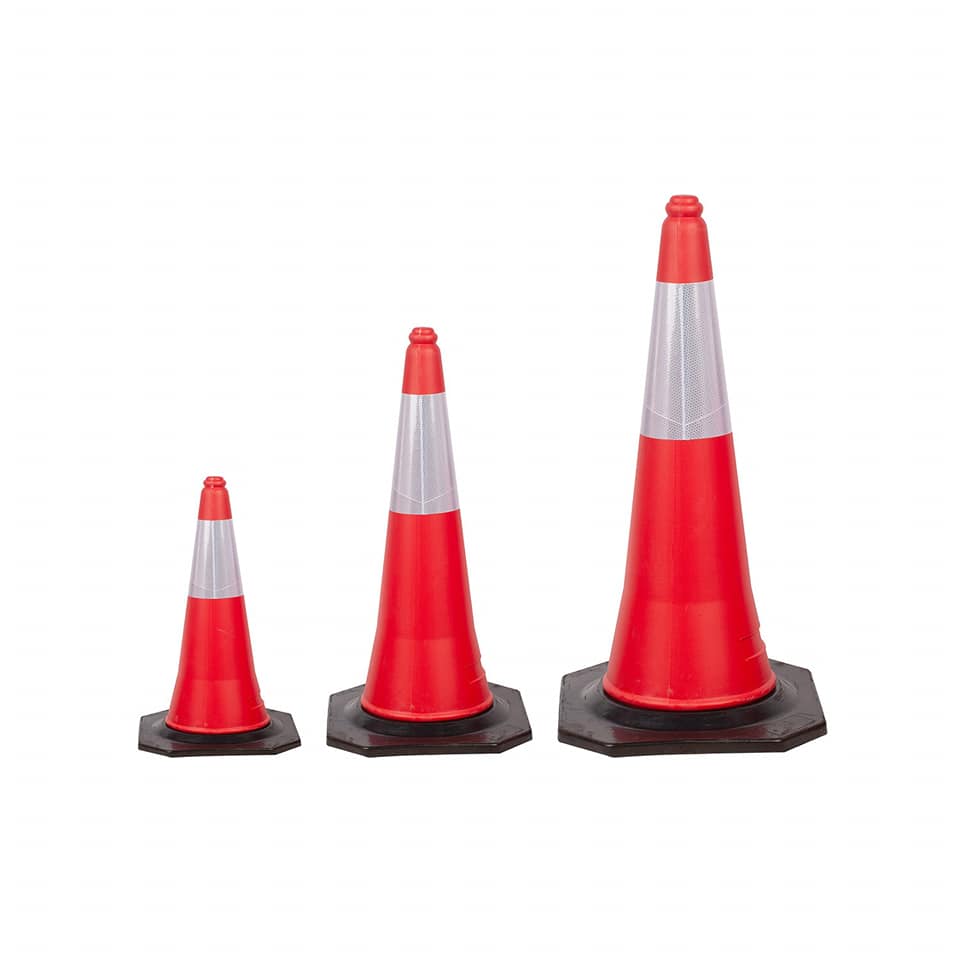
Some traffic cones use a black base made from recycled material. In the market, suppliers often call this a "rubber base", although the actual material can vary. It may be recycled PVC, rubber-like recycled material or another recycled compound.
Compared with a base made from virgin PVC, this type of black recycled-material base can be significantly heavier when the dimensions are the same.
So you may have two traffic cones with:
• The same height
• Similar base dimensions
• Similar appearance
but noticeably different total weights because the base material is different.
For example:
Virgin PVC cone + virgin PVC base
→ generally lighter
PVC cone + black recycled-material base
→ generally heavier
This is one reason we recommend asking suppliers exactly what the quoted weight includes and what material is used for the base.
The term "rubber base" is commonly used in the PVC traffic cone market, but it does not always mean the base is made from natural or synthetic rubber.
4. Wall Thickness
The thickness of the cone body also affects weight.
A thicker wall will normally require more material.
However, thicker does not automatically mean better.
For a flexible PVC traffic cone, the material needs to have the right balance between strength and flexibility. Making the wall thicker simply to increase weight is not necessarily the best approach.
5. Material
PVC and PE traffic cones can have very different constructions.
PVC is commonly used when flexibility is important. A well-formulated PVC cone can bend when hit and then bounce back toward its original shape.
PE cones are generally more rigid and are often produced with a separate cone body and base. They are also commonly chosen when a lower-cost solution is the priority.
So when comparing the weight of a PVC cone with a PE cone, it is important to compare the complete construction rather than the number on the scale.
6. Material Formulation
This is particularly important for PVC traffic cones.
PVC products can contain different proportions of resin, plasticizers, stabilizers and mineral fillers.
One of the fillers commonly used in PVC products is calcium carbonate.
Adding mineral filler can increase the density and weight of the finished product.
This means a heavier PVC traffic cone is not necessarily made with more PVC resin or better-quality material.
That is something buyers should keep in mind when comparing products from different factories.
Common Traffic Cone Weight Options
There is no universal weight for each traffic cone size.
However, these are examples of configurations commonly found in the market:
| Cone Height | Example Weight Options |
|---|---|
| 30cm | Lightweight versions |
| 45cm | Around 1.0kg / 1.4kg |
| 70cm | Around 1.75kg / 2.25kg / 3.2kg |
| 90cm | Around 3.4kg / 4.0kg / 4.5kg |
These numbers are commercial examples, not international standards.
The correct weight depends on the cone design, base, material, application and local requirements.
This is why you should be careful when a supplier says:
"Our 70cm cone is 3kg."
That number alone does not tell you enough about the product.
Is a Heavier Traffic Cone Better?
Not necessarily.
This is probably the most important thing to understand when comparing traffic cone quotations.
A heavier cone can be useful when you need greater stability, particularly outdoors or in areas exposed to wind and vehicle movement.
But there are several ways to make a cone heavier.
For example, the additional weight may come from:
• A larger base
• A thicker base
• A denser recycled-material base
• Greater wall thickness
• More mineral filler
• A different material formulation
These changes do not all have the same effect on product performance.
A heavier PVC cone that remains flexible and recovers well after impact can be a good product.
But a cone that is heavy mainly because of excessive mineral filler is a different story.
So:
Heavy does not automatically mean high quality.
Why Calcium Carbonate Can Make a PVC Cone Heavier
This is particularly relevant when comparing low-cost PVC traffic cones.
Calcium carbonate is a mineral filler that can be used in PVC manufacturing.
One of its effects is to increase the density of the finished material.
So if two cones have similar dimensions but one weighs significantly more, part of the difference may come from the material formulation.
This does not mean calcium carbonate is always bad.
The issue is how much is being used and how the overall PVC formulation is balanced.
If too much filler is used, the material can become harder and less flexible.
For traffic cones, this matters because flexibility is one of the main reasons buyers choose PVC.
A cone used on a road may be knocked over or driven over. A flexible PVC cone should be able to deform and recover rather than remaining permanently bent.
That is why we would not recommend choosing between two PVC cones based on weight alone.
Traffic Cone Weight vs Stability
Weight does have a direct relationship with stability, but it is not the only factor.
A heavier base can make it more difficult for wind or vehicle movement to push the cone out of position.
At the same time, base design matters.
Important factors include:
• Total weight
• Base dimensions
• Base shape
• Base material
• Cone height
• Center of gravity
• Surface conditions
For example, a wider base can improve stability without simply adding more weight to the entire cone.
This is especially important for buyers who need to balance stability with handling.
How Much Should a 70cm Traffic Cone Weigh?
There is no single correct weight for a 70cm traffic cone.
When sourcing from China, you may find a surprisingly wide range of weight options for the same 70cm cone. Depending on the material, base design and target price, suppliers may offer anything from around 1.4kg to 3.2kg or even more.
Here are some common configurations you may come across:
1.4–1.6kg
Some Chinese suppliers offer 1.4kg or 1.6kg 70cm cones to keep the product price competitive.
These lighter versions can be suitable for applications where easy handling and lower transportation costs are more important than maximum stability.
However, when comparing a very light cone with a heavier version, don't look at the weight alone. Check the base dimensions, material and overall constructionto understand where the weight difference comes from.
1.75kg
A relatively light configuration that offers a good balance between portability and basic stability.
It can be a practical option for general applications where the cone does not need to withstand strong wind or heavy traffic conditions.
2.25kg
A more substantial configuration that provides a better balance between handling and stability.
This is often a practical choice for outdoor applications where you need more stability but don't want the cone to become unnecessarily heavy.
3.2kg
A heavier configuration normally seen with a black recycled-material base, which is commonly referred to by suppliers as a "rubber base."
The heavier base adds significant weight and provides greater resistance to movement, making this type of cone suitable for applications where stability is more important.
However, remember that the additional weight is largely related to the base material and construction. It does not necessarily mean that the PVC cone body itself contains more or better-quality material.
These are commercial configurations you may encounter in the Chinese market rather than universal standards.
If you are buying 70cm cones for road construction, the appropriate weight should be determined by the application, required stability and local project specifications.
And when one supplier offers several different weights, don't just ask:
"Which one is better?"
Ask:
"What changes between the different versions?"
Is it:
• The base material?
• The base dimensions?
• The wall thickness?
• The PVC formulation?
• The manufacturing process?
Once you understand where the weight difference comes from, it becomes much easier to compare the products and decide whether the extra weight is actually worth paying for.
How Much Should a 90cm Traffic Cone Weigh?
The same principle applies to 90cm traffic cones.
When sourcing from China, you may find 90cm cones with quite different weights, even when the height and general appearance look similar.
Common configurations include:
• Around 3.0kg or less
• 3.4kg
• 4.0kg
• 4.5kg
3.0kg or Less
Some suppliers produce fully orange 90cm traffic cones at around 3.0kg or even lighter.
These cones are usually designed with a lighter base and overall construction to keep the product cost competitive.
They can be suitable for applications where portability and price are important, but they may not provide the same stability as a heavier 90cm cone.
If you are comparing a lightweight 90cm cone with a heavier version, check the base dimensions and material rather than looking at the weight alone.
3.4kg
A 3.4kg configuration provides more weight than many lightweight 90cm cones and can offer a reasonable balance between handling and stability.
The actual performance still depends on the base design and material formulation.
4.0kg
A 4.0kg 90cm cone is a more substantial configuration and may be preferred for outdoor work zones where greater stability is required.
For some markets and road-work applications, this weight may also be specified by the customer or project requirements.
4.5kg
A 4.5kg 90cm cone is commonly made with a black recycled-material base, which suppliers often refer to as a "rubber base."
The black base is generally much denser than a lightweight virgin-PVC base, which is why it can add a significant amount of weight while keeping the cone body itself relatively similar.
This type of construction is often chosen when greater stability is required.
However, the additional weight mainly comes from the base material and construction. It should not automatically be interpreted as meaning that the cone body is made from better-quality PVC.
These are examples of commercial configurations commonly found in the Chinese market, rather than universal standards.
This is also why two suppliers can quote very different prices for a "90cm traffic cone." One may be offering a 3.0kg fully orange cone, while another is offering a 4.5kg cone with a black recycled-material base. They are not really the same product, even though both are described simply as "90cm traffic cones."
When comparing quotations, make sure you check:
• Total weight
• Base dimensions
• Base material
• Cone material
• Wall thickness
• Reflective sheeting
• Overall design
And if a project specifies a minimum weight, height or other technical requirement, always follow the customer, tender or local road standard rather than choosing a weight based only on what is commonly available in the market.
A 4.5kg cone is not automatically better than a 3.4kg cone. The important question is whether the extra weight provides the stability and performance your application actually requires.
Does a Heavy Base Always Mean a Better Cone?
Not always.
A heavy base can improve stability, but there is a practical limit.
A very heavy cone also means:
• More material cost
• Higher transportation weight
• More difficult manual handling
• More weight inside the container
• Potentially higher logistics costs
Imagine you are buying 5,000 cones.
If one version is 1kg heavier than another, that means:
5,000 × 1kg = 5,000kg
You are adding five tonnes of product weight.
If that extra weight does not provide a meaningful benefit for your application, you may simply be paying more for the product and logistics.
The goal should be:
Enough weight for the required stability — not the maximum possible weight.
Traffic Cone Weight and Shipping Cost
Weight becomes even more important when buying traffic cones in large quantities.
For local purchases, the difference between a 2.25kg and 3.2kg cone may not seem important.
For a container order, it can become significant.
The additional weight can affect:
• Container loading
• Trucking
• Handling
• Shipment weight
• Freight cost
This is why we recommend looking at the total landed cost, rather than comparing the traffic cone unit price alone.
A cheaper cone can sometimes cost more overall if it has unnecessary weight or inefficient packaging.
Read our Traffic Cone Packaging Guide →
PVC Traffic Cone Weight vs Flexibility
For PVC cones, there is another trade-off worth understanding.
PVC is often chosen because it can be flexible.
When a vehicle hits a flexible PVC cone, the cone can bend and then return toward its original shape.
But the formulation matters.
If the PVC is heavily filled or the material becomes too hard, the cone may lose some of that flexibility.
This is why a 3.2kg PVC cone is not automatically better than a 2.25kg PVC cone.
For many applications, the better product is the one that provides the right combination of:
Stability + Flexibility + Durability + Weight
rather than simply the highest weight.
PVC vs PE: Does Material Affect Weight?
Yes.
The material and construction of the cone can have a significant effect on its weight.
PVC Traffic Cones
PVC cones are generally more flexible.
They can bend under impact and recover toward their original shape.
This makes them suitable for applications where cones may be knocked over or driven over.
PE Traffic Cones
PE cones are generally less flexible.
They are often made with a separate cone body and base, which can make production and transportation more economical.
PE is often selected when the buyer is looking for a lower-cost traffic cone and does not need the same level of flexibility as a PVC cone.
So if you are comparing PVC and PE, don't simply ask:
"Which one is heavier?"
The more useful questions are:
What is the base made from?
Is the cone flexible?
Is the base separate?
What level of stability do you actually need?
How to Compare Two Traffic Cone Quotations
Imagine you receive these two quotations:
Supplier A
70cm PVC traffic cone — 2.25kg
Supplier B
70cm PVC traffic cone — 3.2kg
It is easy to assume Supplier B is offering a better product.
But you still need to know:
• Base dimensions
• Base material
• Cone wall thickness
• PVC formulation
• Reflective sheeting
• Flexibility
• Packaging
The extra 950g could be coming from a heavier base, a different formulation or simply more filler.
So the correct conclusion is not:
3.2kg is better than 2.25kg.
It is:
3.2kg is heavier. Now we need to understand why.
That is a much better way to compare traffic cones.
How Should You Specify Traffic Cone Weight?
When requesting a quotation, don't simply write:
70cm traffic cone
A better specification would be:
70cm PVC traffic cone, total weight 2.25kg, orange, 350 × 350mm base, two reflective bands, flexible design.
If you are still deciding on the weight, ask the supplier to quote several versions:
Please quote 70cm PVC traffic cones in 1.75kg, 2.25kg and 3.2kg configurations. Please indicate the base dimensions and material for each option.
This gives you a much better basis for comparing price and performance.
What Weight Should You Choose?
There is no universal "best" weight.
As a general starting point:
Lightweight
Good when easy handling, portability and lower transportation weight are important.
Medium Weight
Suitable for many general outdoor applications where you need a balance between stability and handling.
Heavy Duty
Useful for demanding outdoor applications, road construction and work zones where greater resistance to movement is required.
But if your customer, tender or local standard specifies a minimum weight, that requirement takes priority.
Frequently Asked Questions
What is a good weight for a traffic cone?
There is no single ideal weight. It depends on the cone height, base design, application and stability requirements.
Is a heavier traffic cone always better?
No. A heavier cone can be more stable, but additional weight may come from a heavier base, recycled material or mineral filler rather than better overall construction.
Why are some PVC traffic cones heavier than others?
Differences in base dimensions, wall thickness, base material and PVC formulation can all affect the final weight.
Can calcium carbonate make a traffic cone heavier?
Yes. Calcium carbonate is a mineral filler that can increase the density and weight of PVC products. However, using more filler does not automatically mean higher quality.
Why is a black traffic cone base sometimes called a rubber base?
Many suppliers use the term "rubber base" for black recycled-material bases. However, the actual material can vary, so buyers should confirm whether the base is recycled PVC, rubber or another recycled compound.
How much does a 70cm traffic cone weigh?
Common commercial configurations can include around 1.75kg, 2.25kg and 3.2kg, but there is no universal standard weight.
How much does a 90cm traffic cone weigh?
Depending on the design, 90cm cones may be supplied around 3.4kg, 4.0kg or 4.5kg. The appropriate weight depends on the application and market requirements.
Does the base affect traffic cone stability?
Yes. Base weight, dimensions, shape and material all affect stability.
Conclusion
When buying traffic cones, don't use weight as a shortcut for quality.
A heavier cone may be the right choice when you need more stability. But the extra weight could come from a larger base, a recycled-material base, thicker construction or mineral fillers in the PVC.
For PVC cones in particular, flexibility is also important. A cone that is slightly lighter but bends and recovers properly may be more suitable than a heavier cone that has become unnecessarily stiff.
For bulk purchasing, compare the complete specification:
Height + Weight + Base + Material + Flexibility + Reflective Sheeting
And always make sure different suppliers are quoting the same specification.
That is the only reliable way to know whether a heavier traffic cone is actually worth the extra cost.
Need Help Choosing the Right Traffic Cone Weight?
If you are comparing different traffic cone weights for your market, send us the cone size, application, destination country and quantity.
We can help you compare different weight and base configurations and work out a practical specification before you place a bulk order.
Request a Traffic Cone Quote →