Welcome to China Traffic Cone Supplier & Road Safety Products | SLOAN SAFETY
How to Identify a Good Solar Road Stud ?
Solar road studs look quite similar when you compare them in a catalog.
The difference usually becomes clear when you look at the details.
Over the years, we have compared different solar road stud samples from different factories. Some products look almost identical on the outside, but the components and manufacturing process can be quite different.
For buyers, this is also why you may receive very different prices for what appears to be the same product.
If you are sourcing solar road studs, these are the points we recommend checking.
1. Check the Reflective Part
Let's start with the two parts that directly affect nighttime visibility: the reflective material and the LED.
Good solar road stud uses a microprismatic reflective sheet together with a Φ5 high-brightness explosion-proof LED. According to the product specification, the reflective system has a luminous intensity of more than 22,000 MCD, with a long service life.
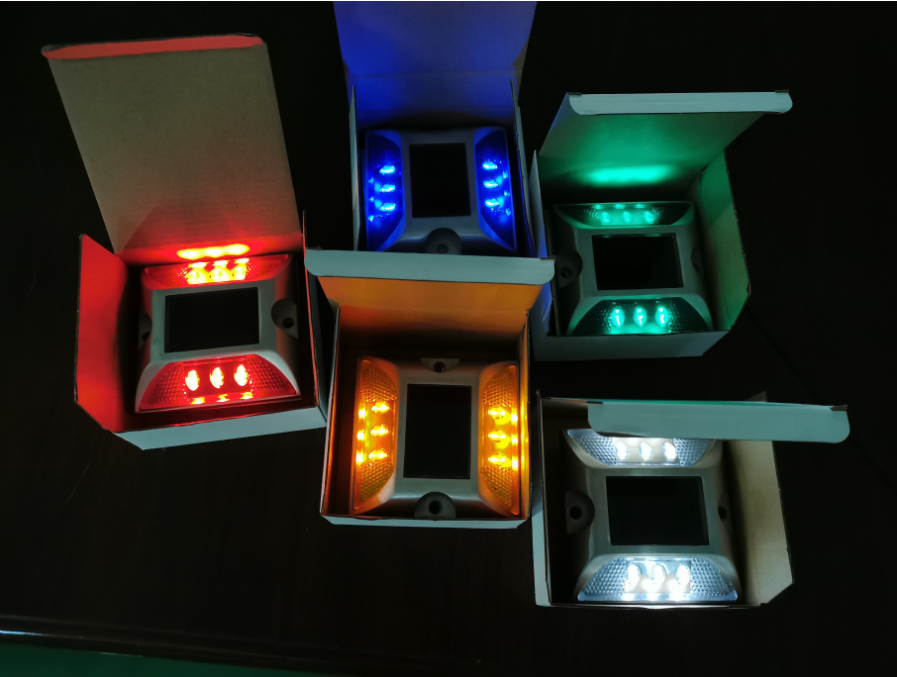
When we compare samples, the difference between good and low-cost reflective material can be quite obvious at night. Some low-cost products have very little visible reflection when there is no LED light.
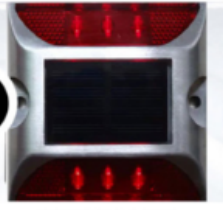
This is something you cannot really judge from a product photo.
If you are comparing suppliers, ask them for a nighttime video or test the samples yourself.
Ask your supplier:
• What type of reflective material is used?
• Is it microprismatic?
• Can you provide a nighttime test?
• What is the reflective performance?
2. Don't Forget About the Battery
The battery is hidden inside the road stud, so it is easy to overlook.
But it can make a big difference to the service life of the product.
It will be good quality If one solar road stud uses a high-temperature-resistant NiMH battery, which is designed to work normally at temperatures up to 80°C. The stated battery life is more than 5 years, and after around 8 hours of sunlight, the product can work for up to 72 hours.
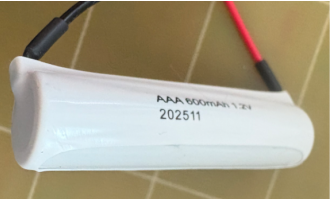
We have also seen low-cost products using batteries with exposed positive and negative terminals. This can increase the risk of short circuits, and the expected battery life can be less than one year.
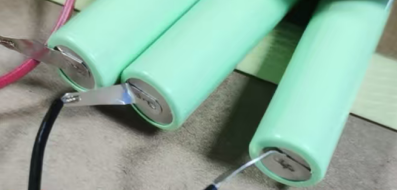
So if one supplier is much cheaper than another, the battery is one of the things worth checking.
3. Check the Solar Panel
The solar panel is another part that is easy to overlook.
It is responsible for charging the battery during the day, so its performance directly affects how long the solar road stud can continue working at night.
For solar road studs, monocrystalline silicon solar panels are widely used because they generally offer relatively high photoelectric conversion efficiency. A conversion efficiency of around 14% is common in some product configurations, allowing more of the available sunlight to be converted into electrical energy.
But efficiency is not the only thing to look at.
The Surface Needs to Withstand Traffic
Unlike a solar panel installed on a roof, a road stud is installed directly on the ground.
Every day, the surface may be exposed to:
• Vehicle tires
• Dust and sand
• Rain
• Dirt
• Repeated friction
• Outdoor temperature changes
This means the solar panel needs to have sufficient surface hardness and wear resistance.
If the surface scratches too easily, the scratches and wear can gradually reduce the amount of light reaching the photovoltaic cells. Over time, this can affect the panel's ability to convert sunlight into electricity.
This is why we pay attention not only to the electrical performance of the solar panel, but also to its surface hardness and wear resistance.
When comparing samples, take a close look at the panel surface.
4. Pay Attention to the Glue Filling
This is one of those details that most buyers cannot see from the outside.
Inside a solar road stud are the battery, circuit and other electronic components. They need to be properly protected from water and the outdoor environment.
The production uses an automatic glue-filling machine. This helps keep the amount of epoxy resin more consistent and gives the finished surface a more even appearance. The epoxy resin used is stated to remain durable for around 2–3 years without yellowing.
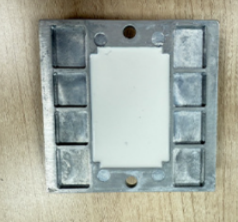
Some low-cost products use manual glue filling. In the samples described in our comparison, the epoxy resin could yellow after several months and separate from the housing, which affected the waterproofing.
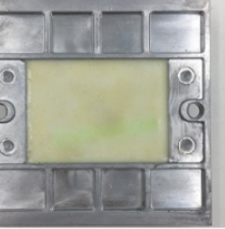
When you receive a sample, take a close look at the resin.
Check for:
• Uneven filling
• Gaps
• Bubbles
• Separation
• Yellowing
These small details can tell you quite a lot about the production process.
5. Check How the Reflective Part Is Fixed
Another detail worth checking is how the reflective part is attached to the housing.
For a good quality road stud, epoxy resin fills the space between the reflective part and the housing. This gives the reflective piece more support and helps prevent it from coming loose.
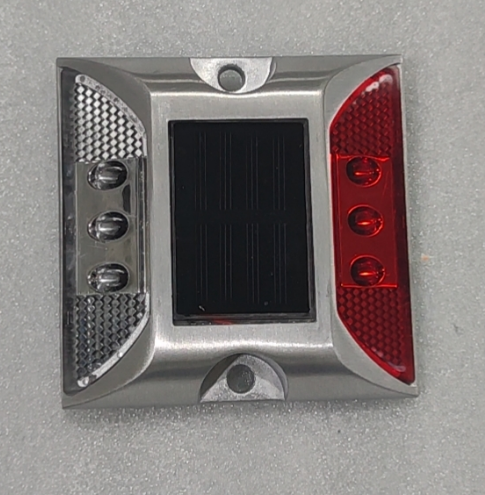
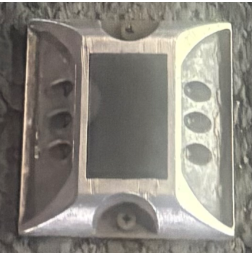
In some low-cost products, only a small amount of glue is applied around the reflective piece, leaving a hollow space underneath.
The product may look perfectly fine when you receive it.
6. Ask About Waterproofing
Solar road studs are installed outdoors, so waterproofing is obviously important.
You may see suppliers describe their products as IP68, but I would still ask how the product is sealed.
For example:
• How is the housing sealed?
• Is epoxy resin used?
• How is the glue applied?
• Is the filling process manual or automatic?
• Has the finished product been tested?
The sealing process matters because poor glue filling or poor-quality resin can eventually lead to separation and water getting into the product.
So don't just look at the IP rating on the specification sheet. Take a look at how the product is actually made.
But after some time outdoors, the reflective part can start to come away from the housing. In the comparison from our production team, this happened to some low-cost samples after around 1–2 months.
7. Check Compression Resistance and Installation
Before ordering, make sure the road stud is suitable for the place where you plan to use it.
A product installed in a parking area doesn't necessarily face the same conditions as one installed directly on a traffic lane.
Ask the supplier about:
• Compression resistance
• Recommended application
• Installation method
• Suitable adhesive
• Asphalt or concrete installation
If the road stud will be driven over regularly, this is something you should confirm before placing the order.